Be One UT Strategic Plan

A Roadmap to the Greatest Decade and Beyond

The Be One UT 2025–2030 Strategic Plan provides a clear roadmap for advancing the mission of serving Tennesseans and beyond through education, discovery and outreach. Grounded in measurable priorities and systemwide collaboration, the plan guides how UT will expand opportunity, strengthen impact and deliver meaningful results for the people of Tennessee.

A Roadmap to the Greatest Decade and Beyond

Key Components of Our Framework

UT’s mission and values are key components of our strategic plan, and they remain constant. This plan adds clarity through defined priorities, measurable targets and shared accountability across the UT System.
Our Strategic Framework

The 2030 Strategic Priorities and Enablers are the result of an iterative and collaborative planning process grounded in broad engagement across the UT System. More than 500 stakeholders participated through surveys, interviews, focus groups and leadership work sessions, helping shape the priorities that accelerate access and student success, drive research and innovation, fuel workforce development and advance community engagement. This process strengthened alignment across campuses and institutes, built meaningful stakeholder buy-in and established shared ownership of the measurable goals outlined in the 2025–2030 Strategic Plan.
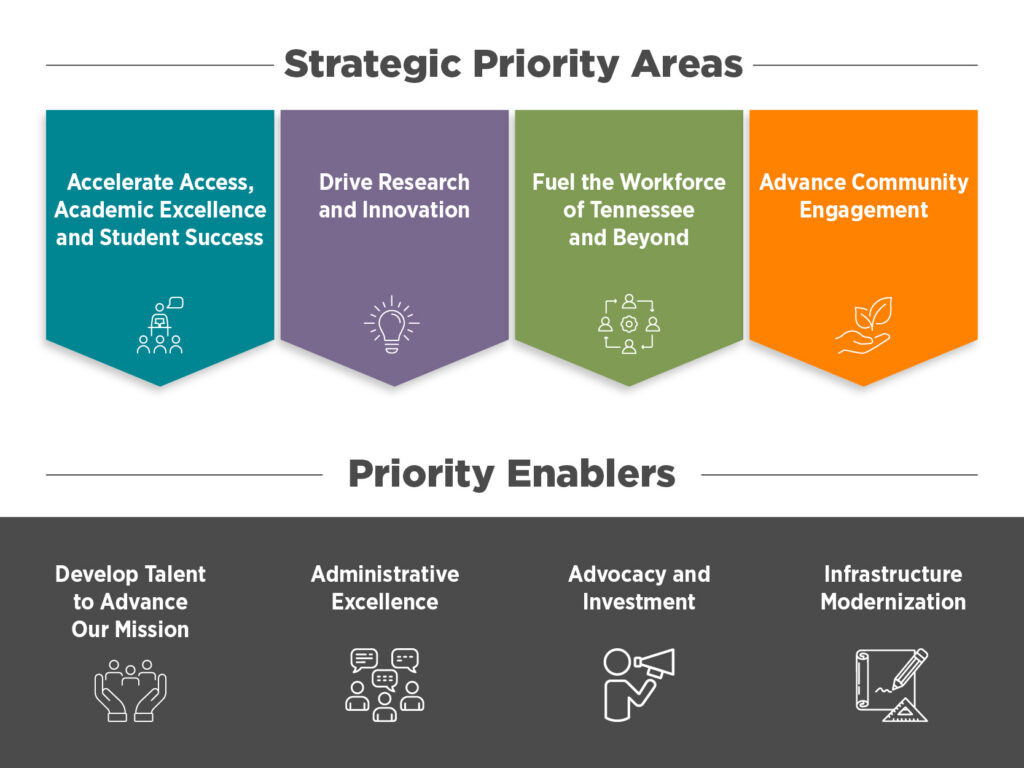
Graphic of strategic priority areas and enablers.

Strategic Priorities

Vision:

Elevate the well-being and economic standing of Tennesseans and beyond through a transformative academic experience, leading to valued credentials, rewarding careers and prosperous futures for all learners.

KPIs2025 Baseline2030 Target
Enrollment: total enrollment and fully online enrollment64,866/6,88085,000/17,000
Students who graduate without debt (undergraduate)55.3%64%
Average in-state student debt (undergraduate)$24,761$20,000
First-year retention rate85.8%90%
Four-year graduation rate57.7%61%
Positive post-graduation career outcomes (undergraduate)86%90%

Vision:

Position UT as a global leader in research and innovation that delivers economic and societal benefits to Tennessee and the world.

KPIs2025 Baseline2030 Target
Total annual research expenditures$524.1M$730M
Federal funding attributed to UT advocacy$42.5M$300M (2026-2030)
Total research funding associated with National Labs$24M$30M
Licenses executed annually47 licenses52 licenses

Vision:

Leverage the unique potential of UT to be the workforce engine of Tennessee, setting a nationwide example for the value of higher education.

KPIs2025 Baseline2030 Target
New units of measure for degrees/credentials of value02
Workforce-aligned microcredentials awarded12,40020,900
Undergraduates who participated in work-based learning (internships/co-ops)23% of graduates35% of graduates
Learners earning credentials in in-demand occupationsIn development with state partnersTBD
Increase cohorts of medical doctors (MDs) and physician assistants175 (MD)/30 (PA)225 (MD)/60 (PA)

Vision:

Transform communities across Tennessee by forging powerful alliances that drive positive change, improve health and quality of life, and deliver tangible benefits for all Tennesseans.

KPIs2025 Baseline2030 Target
The economic impact of the University of Tennessee
(total and by campus/institute)
In developmentTBD
Grow community impact of IPS$49M
(Total Revenue)
$80M
(Total Revenue)
Increase the number of campuses classified as Community Engaged Institutions by the Carnegie Foundation2 of 55 of 5
Increase rural dental residencies04

Strategic Enablers

Vision:

Attract, retain, and develop the exceptional talent, anchored in the Be One UT values, needed to position UT as the employer of choice in Tennessee and set UT on a trajectory of continued excellence.

KPIs2025 Baseline2030 Target
Faculty Net Satisfaction Score (COACHE)71%
(Satisfied/Very Sat.)
75%
(Satisfied/Very Sat.)
Staff Net Promoter Score (McLean)28.950
Professional development participation rate (internal)59.9%75.0%
Internal promotion rate18.9%30%
Employee turnover rate12%10%

Vision:

Drive streamlined operations, processes, security and analytical decision-making through the scaling of our enterprise technology infrastructure.

KPIs2025 Baseline2030 Target
Implement a common student information system
(Oracle Student Cloud)
Launch Phase 1: Student Financial Aid (SFA)SFA complete; Oracle Student Management in final phase
User satisfaction with technology solutionsIn developmentTBD
Total University revenue$3.5B$4.6B
University endowment$1.7B$2.5B
All campuses with 90 to 180 days cash3 of 55 of 5

Vision:

Drive streamlined operations, processes, security and analytical decision-making through the scaling of our enterprise technology infrastructure.

KPIs2025 Baseline2030 Target
UT state policy and budget priorities advanced84.6%100%
Tennessee residents agree that UT offers a
high-quality education
73.0%85.0%
State-supported sponsored projects secured
by GRAED (cumulative)
$183.3M$275M
Private support raised$2.45B
(last decade)
$4B
(this decade)

Vision:

Continue to modernize UT’s physical infrastructure to empower the mission and strengthen statewide impact for decades to come.

KPIs2025 Baseline2030 Target
Infrastructure projects supported by non-traditional funding$350M$800M
Number of student residential beds added1,9563,600
Total infrastructure investment for the decade$4.1B$6B

Strategic Plan Archives

Explore the Strategic Plan Archives to see how, over the years, the University of Tennessee System has shaped its future through a proud tradition of collaborative, system-wide planning.